AI & M-Pesa: Inside Kenya's Fintech Revolution (2026)
How is AI transforming M-Pesa and Kenya's fintech sector in 2026? From fraud detection to AI-driven microloans and insurance for the unbanked, explore Kenya's AI-powered financial revolution.
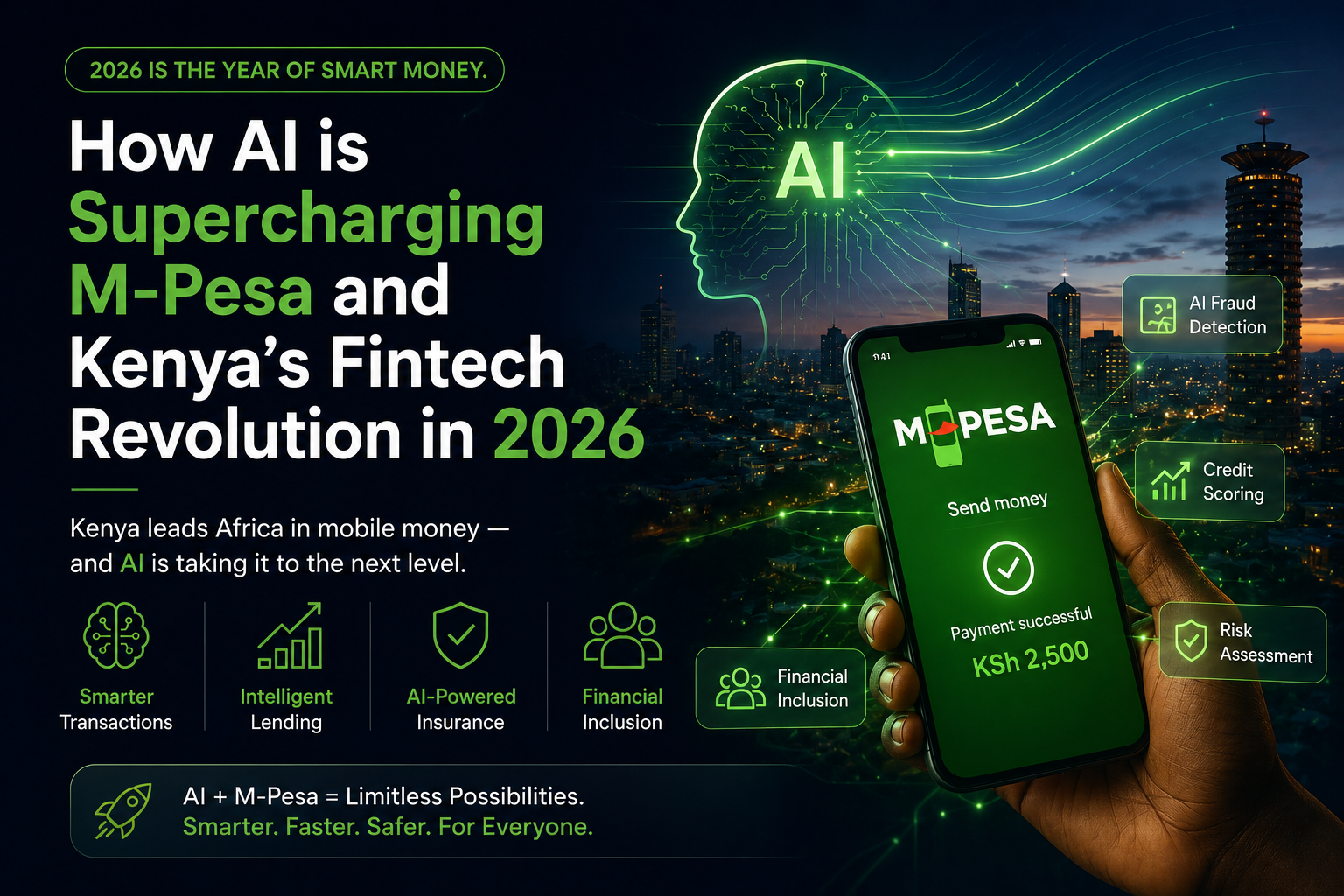
AI & M-Pesa: Inside Kenya's Fintech Revolution (2026)
Kenya has been Africa's fintech capital for nearly two decades. When Safaricom launched M-Pesa in 2007, Kenya showed the world what was possible when mobile technology met financial services. Millions of Kenyans who had never had a bank account suddenly had access to safe, instant, affordable money transfer — directly from their phone.
In 2026, a new wave of innovation is reshaping that story even further. Artificial intelligence is being integrated into every layer of Kenya's financial services ecosystem — and the results are dramatic.
From how fraud is detected on mobile money platforms, to how a boda boda rider in Kisumu qualifies for a microloan in seconds, to how smallholder farmers in the Rift Valley access crop insurance without a single paper form — AI is making Kenya's financial services faster, smarter, fairer, and more accessible than at any point in history.
This is not a story about the future. It is happening right now.
Why Kenya Is the Perfect Environment for AI-Powered Fintech
Before exploring specific applications, it is worth understanding why Kenya is uniquely positioned to lead Africa's AI-fintech revolution.
Extraordinary Mobile Money Penetration
Kenya has the highest mobile money usage rate in the world. Over 65% of Kenyan adults actively use M-Pesa, and M-Pesa transactions now represent a significant percentage of Kenya's entire GDP. Every single one of those millions of daily transactions generates data — and data is the raw material that AI learns from.
The sheer volume of financial activity happening through mobile phones in Kenya creates a data richness that AI can exploit in ways that are simply not possible in markets where mobile money adoption is lower.
A Large Financially Excluded Population With Real Needs
Despite Kenya's mobile money leadership, approximately 17% of Kenyan adults still lack access to formal financial services. This is not a small problem — it represents millions of people who cannot save safely, cannot access credit to grow their businesses, cannot protect their families with insurance, and cannot build the kind of financial stability that lifts families out of poverty.
AI-powered fintech has a direct path to serving this population profitably. The same AI that makes credit decisions for salaried workers can assess the creditworthiness of a market trader using her M-Pesa history, smartphone usage patterns, and transactional behavior — no pay slips required.
A Tech-Forward Regulatory Environment
Kenya's Central Bank has generally taken a progressive approach to fintech innovation, creating regulatory sandboxes that allow new AI-powered financial products to be tested before formal regulation catches up. The government's Digital Economy Blueprint explicitly supports AI adoption across financial services. This regulatory openness is a significant competitive advantage for Kenya over many other African markets.
AI in Action: Six Ways AI Is Transforming Kenya's Financial Services
1. Smarter Fraud Detection That Learns Continuously
M-Pesa processes millions of transactions every single day. Monitoring all of them manually for fraud would require an army of analysts working around the clock — and would still miss sophisticated fraud patterns that evolve daily.
AI makes comprehensive, real-time fraud detection possible. Here is how it works:
For every single transaction, the AI analyzes hundreds of variables simultaneously: the transaction amount, the time, the recipient's history, the sender's typical behavior, the geographic location, the device being used, and dozens of other signals. It compares all of this to patterns it has learned from millions of historical transactions — both legitimate and fraudulent.
This analysis happens in milliseconds, before the transaction completes. If the AI identifies a suspicious pattern, it can halt the transaction, send a verification request, or flag it for human review — all without any human analyst being involved.
The results:
2. Alternative Credit Scoring That Includes the Excluded
For decades, access to credit in Kenya depended on a narrow set of credentials: formal employment records, bank statements spanning years, physical collateral, or a guarantor. For millions of Kenyans — the market trader, the farmer, the boda boda rider, the informal sector worker — these requirements were simply impossible to meet. The result was exclusion from the credit market entirely.
AI is dismantling this exclusionary system by using alternative data to assess creditworthiness:
Products like Fuliza (Safaricom's overdraft product), Tala, Branch, and KCB M-Pesa are all using versions of AI-powered alternative credit scoring to approve loans in seconds — to customers who traditional banks would have turned away without a second thought.
The implications for financial inclusion are profound. Millions of Kenyans who were invisible to the formal credit market are now being served — often accessing credit and starting to build a credit history for the very first time.
3. Hyper-Personalized Financial Products
Traditional financial products were blunt instruments. One interest rate for all personal loans. One premium for all life insurance customers in a given age bracket. One savings account with the same terms for everyone.
AI enables something fundamentally different: financial products tailored to the specific situation, needs, and risk profile of each individual customer.
What this looks like in practice:
This kind of personalization was previously only available to private banking clients. AI makes it economically viable to deliver to customers at every income level.
4. AI-Powered Micro-Insurance for the Unbanked
Insurance penetration in Kenya sits at around 3% of GDP — one of the lowest rates relative to economic size in the world. The reasons are well-documented: products are too complex to understand, premiums are too high for low-income households, distribution relies on agents most people never encounter, and the claims process has a historical reputation for being slow, complicated, and frustrating.
AI is attacking all of these barriers simultaneously.
Product simplification: AI helps design insurance products that can be explained in two sentences and purchased with a single M-Pesa transaction. If the product is not simple enough to describe in plain language in a WhatsApp message, it is not simple enough.
Fairer, more accurate pricing: Traditional insurance pricing uses broad demographic brackets. AI prices risk at the individual level — meaning customers pay what accurately reflects their actual risk, not an average that overcharges low-risk customers while under-pricing high-risk ones. This makes products more affordable for responsible, low-risk customers.
Automatic claims using satellite data: Perhaps the most transformative application is in agricultural insurance. Companies like Pula use satellite imagery, weather station data, and AI to automatically assess crop damage. When drought or flooding reaches a threshold that triggers a policy, payouts are processed automatically and sent via M-Pesa — without the farmer filing any paperwork, waiting for an assessor to visit their shamba, or navigating a complex claims process. The insurance just works.
Micro-insurance at low price points: AI reduces the cost of designing, distributing, and administering insurance products to the point where economically viable products can be offered at premium levels affordable to low-income households — as little as KES 50–100 per month.
5. Conversational AI for Financial Customer Service
Imagine your bank knew your complete financial history, understood your specific situation, could answer your questions accurately and immediately, responded just as well in Swahili as in English, was available at 3am on Christmas Day, and never put you on hold.
That is what AI-powered conversational banking is delivering in Kenya right now.
Banks and mobile money operators are deploying AI assistants that handle the full range of customer service interactions:
The business case is compelling: a single AI customer service system can simultaneously handle thousands of conversations — something that would require hundreds of call center agents to match. Costs drop dramatically. Customer satisfaction improves because response times drop from minutes or hours to seconds. And agents who previously spent their days answering the same repetitive questions can focus on complex cases where human judgment genuinely adds value.
6. AI-Driven Investment and Wealth Management
Kenya's investment culture is growing — with Nairobi Securities Exchange activity increasing and digital investment platforms attracting a new generation of investors. AI is making sophisticated investment guidance available to a much wider audience.
Robo-advisors powered by AI can:
This brings a quality of investment advice previously only available to wealthy clients into the hands of salaried Kenyans with modest savings — democratizing wealth building in a way that has real long-term implications for household financial health.
The Bigger Picture: What AI Means for Financial Inclusion in Kenya
Zoom out and the most significant thing about AI in Kenya's fintech sector is not what it does for customers who already have full access to financial services. It is what it does for those who have historically been excluded.
For the vegetable seller in Muthurwa market: AI credit scoring means she can access working capital financing based on her M-Pesa history — growing her stock, expanding her income, and building a credit history that opens further doors.
For the smallholder maize farmer in Nakuru: AI-powered agricultural insurance means that when the rains fail, he receives an automatic M-Pesa payout that allows him to replant next season — rather than falling into debt or giving up farming altogether.
For the boda boda rider in Eldoret: AI-driven micro-savings tools mean that consistent, automated micro-deposits grow into meaningful emergency savings — providing financial resilience against the unexpected costs that too often spiral into long-term poverty traps.
For the young professional in Nairobi: AI investment platforms mean that even with modest income, she can begin building wealth through diversified, automatically managed investments — a wealth-building pathway previously available only to the relatively affluent.
This is the true promise of AI in Kenya's financial ecosystem: not just efficiency gains for the already-included, but genuine economic empowerment for millions who have been left behind by traditional financial systems.
Challenges the Industry Must Address
No honest account of AI in Kenyan fintech can ignore the genuine challenges:
Data privacy: As AI systems collect increasingly detailed financial and behavioral data, Kenya's Data Protection Act (2019) becomes critically important. Every business deploying financial AI must ensure they have explicit consent for data use, store data securely, and can explain to customers what data is collected and how it is used.
Algorithmic bias: AI credit scoring models can inadvertently discriminate against certain communities if they are trained on historical data that reflects past discrimination. Ongoing auditing of AI models for bias is not optional — it is an ethical and increasingly regulatory requirement.
Over-indebtedness: The ease and speed of AI-driven lending has contributed to over-indebtedness problems in Kenya's mobile lending sector. Responsible AI lending must include affordability assessment, credit bureau integration, and lending limits that protect borrowers from spiraling debt.
Digital literacy gaps: Not every Kenyan is equally comfortable navigating digital financial tools. AI-powered products must be designed with accessibility in mind — including USSD options for feature phone users and interface design that works for people with limited digital literacy.
Rural connectivity: While mobile coverage in Kenya has improved dramatically, reliable data connectivity in some remote areas remains a barrier to AI-powered services that require constant internet connectivity.
What This Means for Your Fintech or Financial Services Business
If you operate in Kenya's financial sector — whether you are a bank, sacco, insurance company, fintech startup, mobile lender, or investment platform — the question is no longer whether to incorporate AI. It is how quickly and how well.
AI is becoming the standard infrastructure of competitive financial services. The institutions that deploy it thoughtfully and effectively will attract customers, control costs, reduce fraud losses, and expand into underserved markets. Those that do not will find themselves increasingly unable to compete on speed, cost, or customer experience.
Alpha AI Kenya's fintech solutions include fraud detection systems, alternative credit scoring engines, customer service AI, and personalization platforms — all designed specifically for the Kenyan financial services regulatory environment.
Frequently Asked Questions About AI in Kenyan Fintech
Q: Is AI in fintech safe? Can it be hacked?
AI systems use the same security infrastructure as any other modern financial technology — encryption, secure APIs, access controls, and regular security audits. The specific risk profile is different from traditional systems, but AI fintech is not inherently less secure. Working with reputable providers who prioritize security is essential.
Q: How does AI credit scoring affect my credit history?
AI credit scoring is becoming part of Kenya's broader credit reference system. Loans made through AI-powered platforms are increasingly reported to credit bureaus — meaning responsible repayment builds a positive credit history, while defaults are recorded negatively, just as with traditional loans.
Q: Can smaller saccos and MFIs afford AI?
Yes. Many AI solutions are available on a software-as-a-service basis, meaning smaller institutions pay a monthly subscription rather than a large upfront capital cost. Our team at Alpha AI Kenya works with financial institutions of all sizes — including saccos and MFIs — to find solutions that fit their budget and scale.
Q: How does AI handle Swahili in financial customer service?
Modern AI language models handle Swahili well and continue to improve. For Kenyan fintech applications, AI customer service systems are typically trained on local financial terminology, common customer queries in both English and Swahili, and even common Kenyan code-switching patterns. The result is a natural, accessible customer experience for both English and Swahili-dominant users.
Q: What regulations govern AI in Kenyan financial services?
The primary regulatory frameworks are the Central Bank of Kenya's guidelines on digital lending and mobile money, Kenya's Data Protection Act (2019), and guidance from the Insurance Regulatory Authority for AI-powered insurance products. Alpha AI Kenya builds regulatory compliance into every fintech solution we deliver.
Q: How long does it take to implement AI in a financial services business?
A focused AI implementation — such as a fraud detection system or customer service chatbot — typically goes live within 6–10 weeks. More complex implementations, such as full AI-powered credit scoring or investment platforms, may take 3–6 months. Contact our team for a realistic timeline assessment specific to your situation.
Conclusion: Kenya's Financial Future Is Being Built on AI
Kenya turned mobile phones into bank branches. Now, AI is turning those mobile bank branches into intelligent financial partners — ones that understand individual customers, make instant decisions, catch fraud before it happens, and extend financial services to communities that traditional institutions never reached.
This is not a distant vision. It is unfolding across Kenya's financial landscape right now, driven by a combination of extraordinary mobile penetration, entrepreneurial energy, progressive regulation, and the rapidly falling cost of AI technology.
The financial institutions and fintech companies that embrace this transition thoughtfully will not just survive it — they will help define what financial services look like across Africa for the next generation.
If you want to understand how AI can help your financial services business grow, reduce risk, and serve more Kenyans, talk to the team at Alpha AI Kenya today. We are here to help you navigate this transformation intelligently and confidently.
Kenya led Africa into the mobile money era. With the right AI strategy, your business can be part of leading Africa into what comes next.
Alpha AI Team
Alpha AI Kenya — Nairobi's leading AI solutions company
The Alpha AI Kenya team shares practical insights on artificial intelligence, machine learning, and digital transformation for businesses across Kenya and Africa. Learn more about us →
Ready to implement AI in your business?
Let Alpha AI Kenya help you identify and build the right AI solution. Free initial consultation — no commitment required.
Get Started Today